My Learning Journey - Java Programming
Mastering Java: From object-oriented fundamentals to advanced control flow.
← Back to PortfolioDay 1
Java & OOPJava and Object-Oriented Programming
On the first day, I learned the basics of Java and the fundamentals of **Object-Oriented Programming (OOP)**. I discovered that Java is a high-level, class-based, and object-oriented language designed with the **"write once, run anywhere" (WORA)** philosophy. I also understood the modularity and reusability benefits of OOP compared to procedural programming.
Topics Covered:
- Introduction to Java: High-level, class-based, object-oriented language
- The Write Once, Run Anywhere (WORA) capability
- The need for OOP: Modularity, code reusability, pluggability
- Procedural vs Object-Oriented Programming paradigm differences
Day 2
Java PlatformJVM, JRE, JDK and Basic Programming
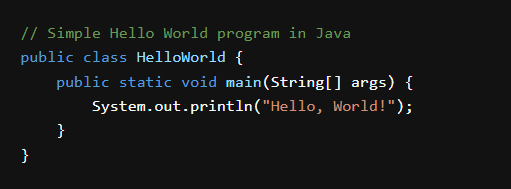
On the second day, I delved into the Java platform components: the **JVM (Java Virtual Machine)**, **JRE (Java Runtime Environment)**, and **JDK (Java Development Kit)**. I understood their roles in compiling and running Java applications. I then wrote my very first "Hello, World!" program, a classic first step in any new programming language, and learned about the diverse applications of Java, from desktop GUIs to enterprise applications.
Topics Covered:
- JVM: The abstract machine that provides the runtime for bytecode execution
- JRE: The implementation of the JVM that provides libraries to run applications
- JDK: The development tools like compilers, debuggers, and documentation tools
- Applications of Java in various domains
- Writing and compiling a basic Java program
Day 3
Java SyntaxJava Features & Program Structure
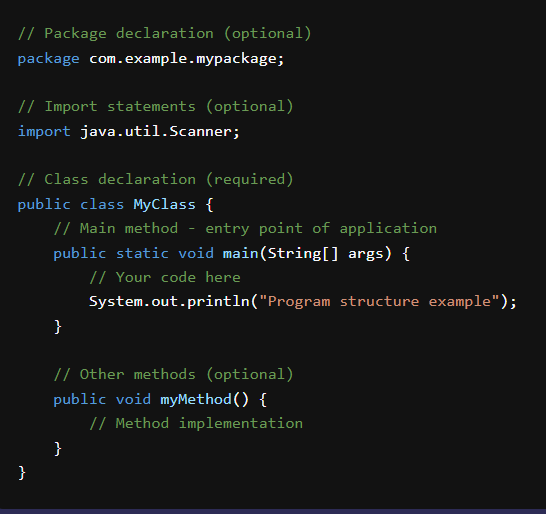
This day focused on the core features and structure of Java. I learned about the **basic syntax** of a Java program, including how to define a **class**, the main method, and how to use comments. I also explored key Java features like being object-oriented, platform-independent, robust, and secure, understanding why it's a popular choice for large-scale applications.
Topics Covered:
- Key features of Java: Object-oriented, Platform-independent, Robust, Secure
- Basic program structure: class declaration, main method
- Understanding Java's simple, portable, and dynamic nature
- Writing single-line and multi-line comments
Day 4
Java FundamentalsVariables, Data Types & Operators
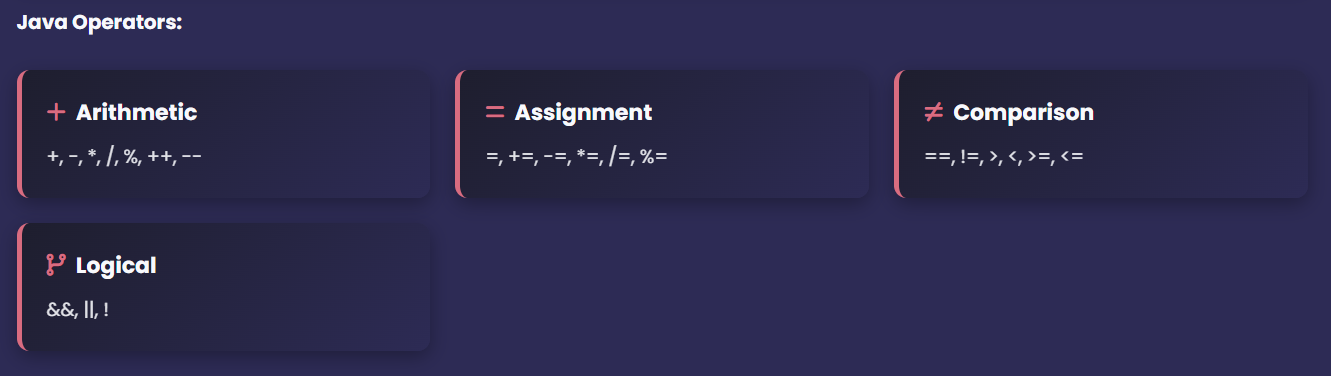
On the fourth day, I learned about **variables**, **primitive data types**, **literals**, and **operators** in Java. I studied the size and description of each primitive type, such as `int`, `double`, and `boolean`. I also gained a solid understanding of the different types of operators used for arithmetic, assignment, comparison, and logic to perform various operations on data.
Topics Covered:
- Declaring and initializing variables
- Primitive data types: `byte`, `short`, `int`, `long`, `float`, `double`, `boolean`, `char`
- Java operators: Arithmetic, Assignment, Comparison, Logical
- Understanding integer and floating-point literals
Day 5
Expressions & OperatorsOperator Precedence and Expression Evaluation
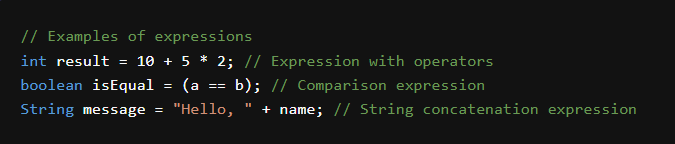
On the fifth day, we covered **expressions, precedence, and associativity** in Java. I learned that an expression is a combination of variables, operators, and method invocations. A key part of this day was understanding the **Operator Precedence Rules**, which determine the order of evaluation in complex expressions. I also studied **associativity** to handle expressions with operators of the same precedence.
Topics Covered:
- Understanding expressions in Java
- Operator Precedence Rules: `postfix`, `unary`, `multiplicative`, etc.
- Associativity: Left-to-right vs. right-to-left evaluation
- Ternary and assignment operators
Day 6
Control StructuresType Conversion and Control Structures
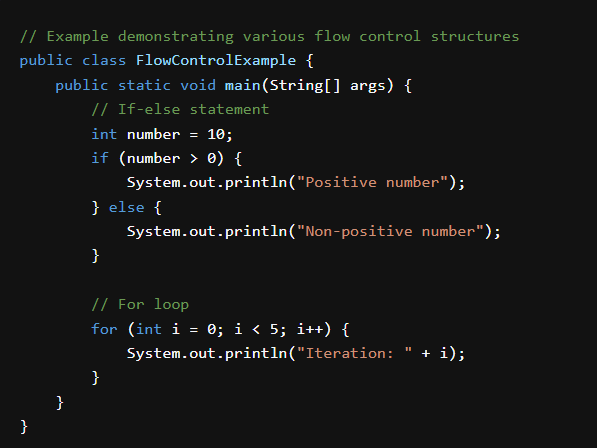
This day focused on how to manage data types and control the flow of a program. I learned about **type conversion**, specifically **widening** and **narrowing casting**. I also mastered the different **flow control structures** that Java provides, including **conditional statements** (`if`, `else`, `switch`), **looping statements** (`for`, `while`, `do-while`), and **branching statements** (`break`, `continue`, `return`), which are essential for creating dynamic and logical programs.
Topics Covered:
- Primitive Conversion and Casting: Widening vs. Narrowing
- Flow Control Structures: Conditional, Looping, and Branching statements
- Implementing `if-else` and `switch` statements
- Using `for`, `while`, and `do-while` loops for iteration
- Keywords like `break`, `continue`, and `return`
Additional Resources
Recommended Books
- "Head First Java" by Kathy Sierra & Bert Bates
- "Effective Java" by Joshua Bloch
- "Java: The Complete Reference" by Herbert Schildt
Online Resources
- Oracle Java Tutorials
- W3Schools Java Tutorial
- GeeksforGeeks Java Programming
- Java Code Geeks
Practice Platforms
- HackerRank Java Challenges
- LeetCode Java Problems
- Codecademy Java Course
- CodingBat Java Exercises